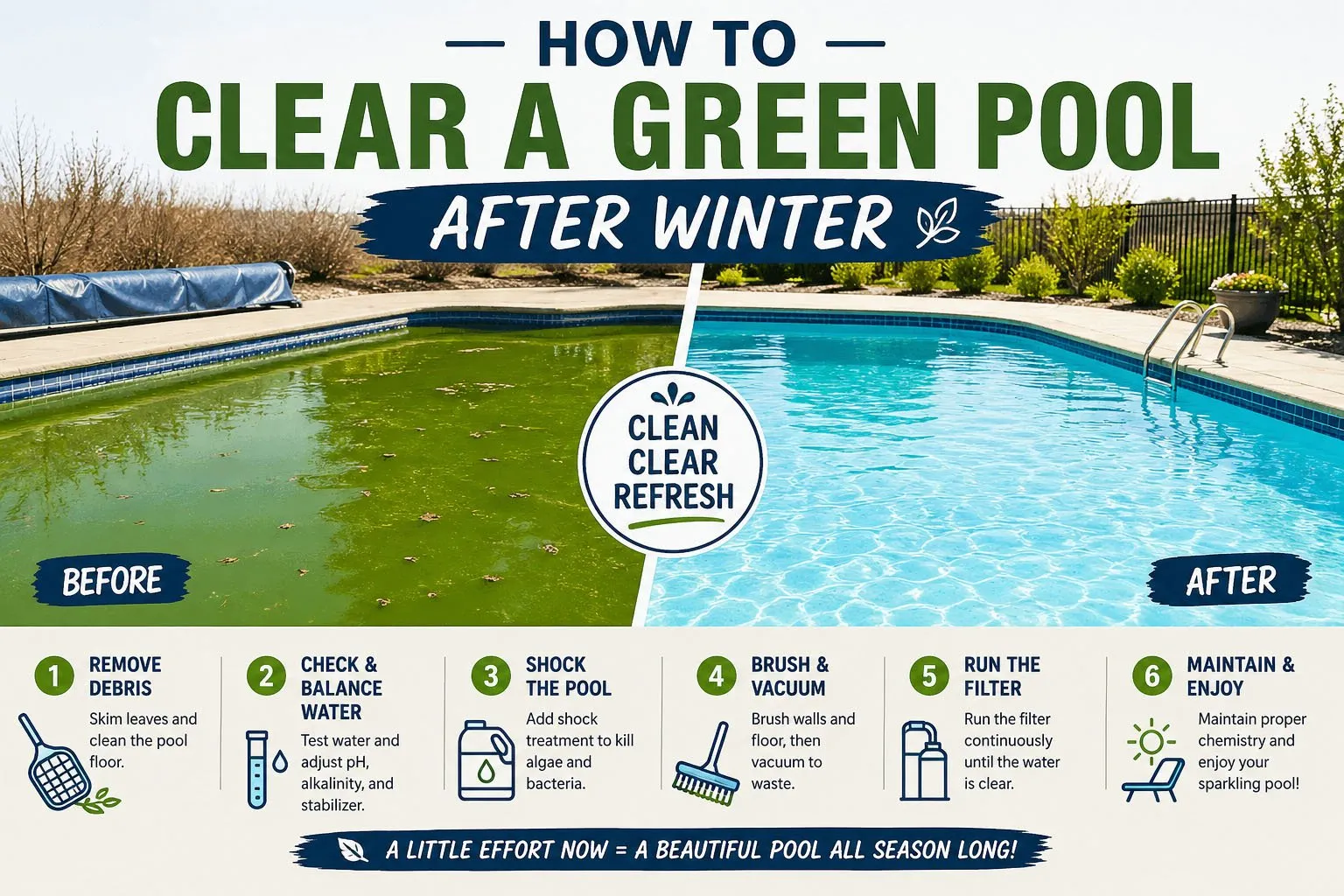
To clear a green pool, brush walls and floor to dislodge algae, balance pH to 7.2, then triple shock with chlorine (3 lbs per 10,000 gallons) and run the filter 24 hours a day until water clears. Most pools turn from green to clean within 3 to 5 days when you follow the right order of operations.
A green pool is alarming, but it’s almost always fixable at home if you act fast. The colour comes from algae blooming in water with low sanitizer or unbalanced chemistry. Below is the exact green to clean process our crews use on service calls, the chemicals you need, what it costs, and when you should stop fighting the pool and call a professional.
Why Your Pool Turned Green
Algae spores are constantly entering your pool through wind, rain, swimsuits and equipment. They only bloom when something else fails. Identifying the cause matters because if you do not fix the underlying problem, the pool will turn green again within a week.
- Low free chlorine. The most common cause. If free chlorine drops below 1 ppm, algae takes off within hours in warm water.
- Heat and sun. Sustained water temperatures above 26°C (80°F) accelerate algae growth, especially in pools without a stabilizer (cyanuric acid).
- Heavy rain or storms. Storm runoff drops phosphates, nitrates and dirt into the pool, feeding algae and diluting your chlorine.
- Filter or pump failure. Stagnant water cannot stay clean. A clogged filter, dead pump or short run time leaves algae undisturbed.
- Unbalanced pH. Chlorine loses up to 90% of its sanitizing power when pH climbs above 8.0. You can have plenty of chlorine and still grow algae.
- Phosphate buildup. Phosphates from fertilizer runoff, leaves and source water are food for algae. High levels make pools much harder to keep clean.
Green to Clean: The 5-Day Process
This is the order our technicians follow on emergency service calls. Skipping steps or doing them out of order is the main reason DIY attempts fail.
Day 1: Test, Skim and Brush
- Skim out floating debris and clean the skimmer baskets and pump basket.
- Test water with a kit that reads pH, total alkalinity, free chlorine, calcium hardness and cyanuric acid. Strips are fine in an emergency, but a liquid test kit is more accurate.
- Brush every surface aggressively: walls, floor, steps, behind ladders. Brushing breaks the algae’s protective layer so chlorine can kill it. Skipping this step is why most home shock treatments fail.
- Run the filter and let it circulate while you gather supplies.
Day 2: Balance pH and Triple Shock
- Adjust pH to 7.2 (the lower end of the safe range). Use pH down (sodium bisulfate) if pH is above 7.4. Lower pH lets chlorine work at peak efficiency.
- Adjust total alkalinity to 80-120 ppm.
- Triple shock the pool. Standard shock dose is 1 lb of calcium hypochlorite per 10,000 gallons. For a green pool, multiply by three: 3 lbs per 10,000 gallons. For dark green or black-spotted pools, quadruple shock.
- Add shock at dusk or after sundown. UV burns off chlorine in daylight and you will lose half your dose.
- Run the filter continuously, 24 hours a day, until the pool is clear. Do not turn it off overnight.
Day 3: Algaecide and Filtration
- Test free chlorine. It should still be above 5 ppm. If it has crashed back below 3 ppm, repeat the shock dose.
- Add a quality polymer-based algaecide (60% concentration or higher) following the bottle’s dose for your pool’s volume.
- Brush the pool again, paying attention to corners, behind the ladder, and under the skimmer.
- Backwash or rinse the filter if pressure has climbed 8-10 psi above clean baseline. Sand and DE filters trap massive amounts of dead algae and clog fast.
Day 4: Vacuum to Waste
- Most of the dead algae is now sitting on the floor as a grey or yellow-green dust. Do not stir it back up.
- Set the multiport valve to WASTE (not filter) and vacuum slowly. This sends dirty water out the backwash line instead of through your filter, where it would clog and recirculate.
- Top up the pool with fresh water as you vacuum to keep the skimmer covered.
- If you do not have a multiport valve, vacuum on the filter setting but be prepared to backwash repeatedly.
Day 5: Polish and Test
- Test all parameters. Target ranges: free chlorine 3 ppm, pH 7.4-7.6, total alkalinity 80-120 ppm, calcium hardness 200-400 ppm, cyanuric acid 30-50 ppm.
- Add a clarifier if water is still slightly hazy. Clarifiers clump fine particles together so the filter can catch them.
- Run the filter another 24 hours.
- If water is clear and chemistry is balanced, the pool is safe to swim. If it is still cloudy or green-tinted, return to Day 2 and repeat.
Identifying the Algae Type
Not all green pools are equal. The shade tells you how aggressive your treatment needs to be.
| Color | Algae Type | Difficulty | Treatment |
|---|---|---|---|
| Light green or hazy | Early green algae | Easy | Single or double shock, 1-2 days |
| Dark green | Established green algae | Moderate | Triple shock, 3-5 days |
| Yellow or mustard | Mustard algae | Hard | Specialized mustard algaecide plus quadruple shock, brush daily |
| Black spots | Black algae | Very hard | Quadruple shock, wire brush each spot, may need multiple treatments |
| Pink or red streaks | Pink slime (bacteria) | Moderate | Shock plus enzyme treatment, clean all equipment |
Chemicals You Need and What It Costs
For a typical 20,000 gallon residential pool, expect to spend $80 to $180 on chemicals for a full green to clean treatment. Here is the shopping list:
- Calcium hypochlorite shock (6 lbs for triple shock on 20,000 gallons): $35-50
- Polymer algaecide (32 oz, 60% concentration): $20-30
- pH down (if needed): $10-15
- Clarifier (1 quart): $15-25
- Test kit or strips: $10-30
- Replacement DE or filter cartridge (often needed after a green to clean): $30-80
Compare that to a professional green to clean service, which typically runs $250 to $600 depending on pool size and severity. The DIY savings only make sense if you already own a working pump, filter and brush, and have the time to babysit the pool for five days.
When to Stop Fighting It and Call a Pro
Some pools cannot be saved at home. Call a professional pool service if any of these apply:
- You cannot see the bottom of the pool at all (visibility under 1 foot)
- The water is black, swampy, or has a strong odor
- You have shocked twice and chlorine still drops below 1 ppm within 12 hours (chlorine demand problem)
- Your pump or filter is not working properly
- Black algae is established and forming spots on plaster
- The pool has been green for more than 3 weeks
- You see dead algae but the water will not clear after 7 days
Book a Puddle Pool emergency service call. Our crews handle severe green pools every week during peak season and can usually have a pool swim-ready in 2 to 4 days using commercial-grade equipment.
How to Prevent Future Algae Blooms
The pool that just turned green will turn green again unless you change something. The basics:
- Maintain free chlorine at 2-4 ppm at all times. Use a floating chlorinator or saltwater system so you never run out.
- Run the filter at least 8 hours a day in summer, 12+ during heatwaves.
- Test water twice a week. Once a week is not enough during pool season.
- Brush walls weekly, even if the pool looks fine. Algae establishes invisibly before you see green.
- Add a weekly maintenance dose of algaecide. Cheap insurance.
- Use a phosphate remover if you live near agricultural areas or have lots of trees.
- Cover the pool when not in use for more than 3 days. Less sunlight, less debris, less algae food.
Most green pool emergencies are caused by a 7-10 day vacation when no one tested the water. If you travel, hire a service for weekly checks or invest in an automatic chlorinator and timer-controlled pump.
Frequently Asked Questions
How long does it take to go from green to clean?
Most green pools clear in 3 to 5 days with proper triple shock, balanced pH and 24-hour filtration. Light green hazes can clear in 24-48 hours. Dark green or mustard algae can take a full week.
Can I swim in a green pool?
No. Algae itself is not directly harmful, but a green pool indicates low chlorine and likely high bacteria. Wait until free chlorine is between 1 and 4 ppm and water is visibly clear before swimming.
How much shock do I need for a green pool?
Triple the normal shock dose. Standard maintenance shock is 1 lb of calcium hypochlorite per 10,000 gallons. For a green pool, use 3 lbs per 10,000 gallons. For black or mustard algae, use 4 lbs per 10,000 gallons.
Why is my pool still green after shocking?
Three common reasons: pH was too high (above 7.6), so chlorine could not work. You shocked during the day and UV burned off the chlorine. Or you have very high chlorine demand from organic load and need a second or third shock. Test pH first and re-shock at dusk.
Should I drain a green pool?
Almost never. Draining a pool risks structural damage from groundwater pressure pushing the shell up. Only drain if the water is so contaminated that chemicals cannot fix it, and only with professional supervision.
Will a flocculant clear my green pool faster?
Flocculant clumps debris together so it sinks to the floor for vacuuming. It does not kill algae. Use it only after shocking has killed the algae and you need to remove the dead particles. Using flocculant on living algae just wastes the product.
Why does my pool keep turning green every week?
You have a chronic problem: low cyanuric acid (chlorine is being burned by UV), a phosphate buildup feeding algae faster than chlorine can kill it, or a filter that is not running long enough. Test cyanuric acid (target 30-50 ppm) and phosphates (under 100 ppb) and extend pump run time.
Can I use bleach instead of pool shock?
Yes in an emergency. Standard household bleach is 5-6% sodium hypochlorite. Use 1 gallon of bleach per 10,000 gallons of pool water as a single dose. For triple shock, use 3 gallons per 10,000 gallons. Bleach works but contains additives in some brands, so use plain unscented only.
Get Professional Help This Week
Puddle Pool Services has been clearing green pools across Texas, Florida, California, Maryland and Canada for over a decade. If your pool has been green for more than a few days, or if you have already tried shocking and it is not working, book a service call before the algae establishes any deeper.
Book a Pool Cleaning or Emergency Service or call your local Puddle Pool branch for same-week scheduling.