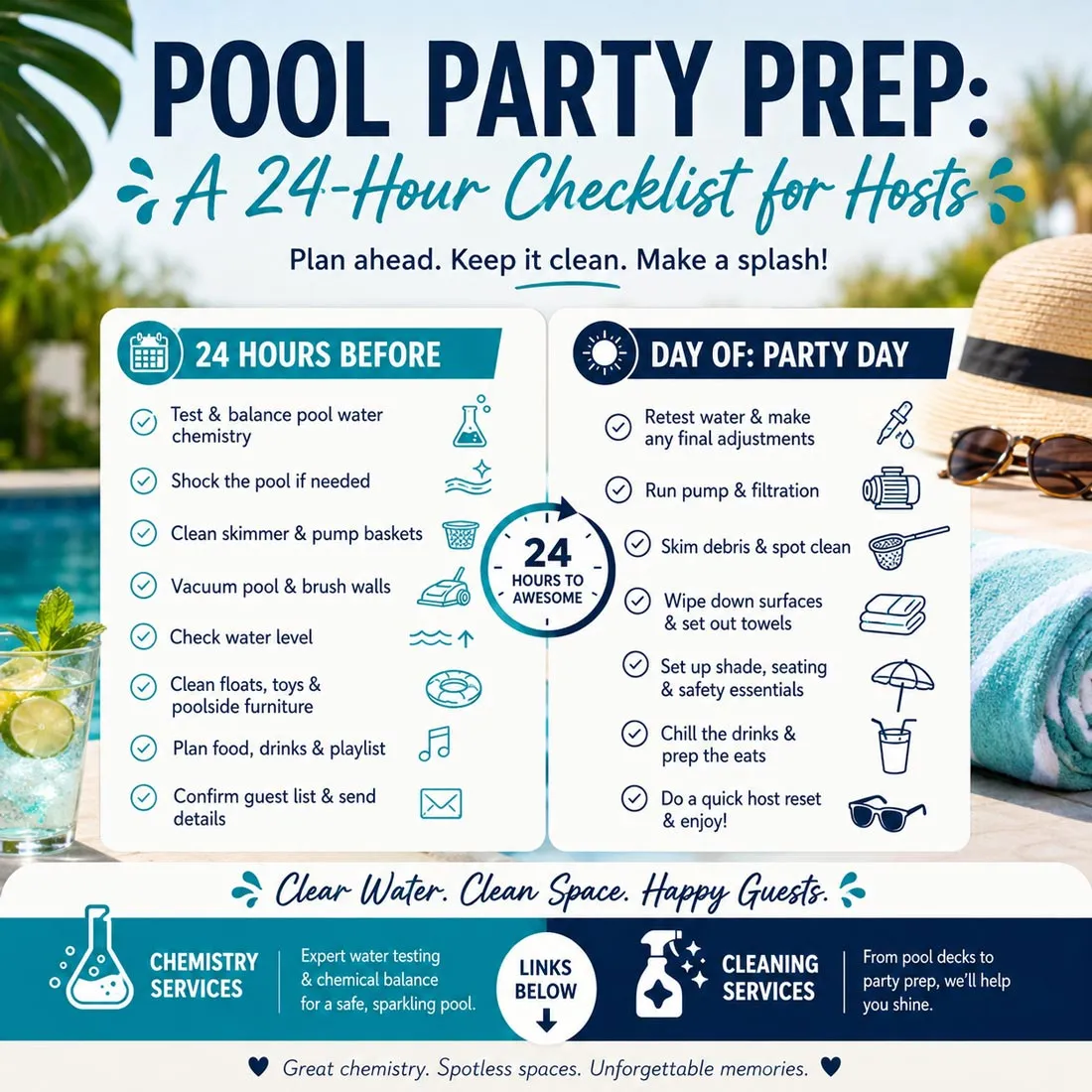
A 24-hour pool party checklist breaks into three blocks: water, surfaces and hospitality. Test and balance water the day before, shock and clarify that evening, vacuum and brush overnight, then handle deck cleaning, safety setup and a final chemistry check two hours before guests arrive. Work backwards from start time and every step has room to settle.
Hosting a pool party feels great until the morning of the event when you spot a green tint at the deep end or notice the patio still has last week’s leaves stuck in the corners. The fix is not a last-minute scramble. It is to spread the work across the day before so every step has time to settle. This checklist walks you through the 24-hour countdown so the water is sparkling, the deck is safe and the chairs are dry before the first guest opens the gate.
Why the 24-Hour Window Matters
Pool water chemistry needs time. Most balancers take 4 to 6 hours to disperse evenly through a residential pool and chlorine shock takes 8 hours minimum to drop back into the safe swimming range below 3 ppm. Vacuuming stirs up fine debris that needs time to settle out through the filter. If you crowd all of that into the morning of your event you get cloudy water, chemical odour and a stressed host. A clean 24-hour runway lets you handle each task in order, catch problems early and still have time to set up the deck before guests arrive.
T-Minus 24 Hours: Test and Balance the Water
Open the countdown the morning before your party with a full water test. Use a liquid test kit or a recently opened bottle of test strips. Skip strips that are more than a year old because the reagents drift and give false readings.
Check four numbers and adjust them in this order:
- Total alkalinity: target 80 to 120 ppm. Alkalinity buffers pH so set it first.
- pH: target 7.4 to 7.6. High pH dulls chlorine and irritates eyes.
- Calcium hardness: target 200 to 400 ppm. Soft water etches plaster.
- Cyanuric acid (CYA): target 30 to 50 ppm for outdoor pools. Too high and your chlorine stops working.
Add adjusters with the pump running. Wait at least four hours before retesting so the chemicals can fully circulate. If you find anything more than two readings off target it is worth calling a professional pool cleaning service first thing in the morning. They can rescue a stubborn pool in one visit.
T-Minus 18 Hours: Shock and Clarify
By early evening your pH and alkalinity should be inside the target ranges. Now hit the pool with a chlorine shock to burn off organic load that built up over the week. Use a calcium hypochlorite shock at the dose printed for your pool volume, usually around 1 pound (454 g) per 10,000 gallons (38,000 L). Dissolve granular shock in a bucket of pool water before pouring into the deep end if your bottle says so.
Wait one full hour, then add a clarifier or flocculant if the water looks hazy. Run the pump overnight on high speed. The combination of shock plus circulation plus filtration is what gives you sparkling water by morning. Cover the pool only if your bottle of shock says it is safe to do so, otherwise leave it open to let chlorine off-gas naturally.
T-Minus 12 Hours: Skim, Vacuum and Brush
If your party starts at noon, this step lands around midnight. You can run it first thing in the morning instead, as long as you finish by 8 a.m. so debris has time to settle and filter out. Either way work in this order:
- Skim the surface with a leaf rake until no floating debris remains.
- Brush walls, waterline tile and steps with a nylon brush (or stainless for plaster).
- Vacuum the floor manually or drop in a robotic cleaner for 60 minutes.
- Empty skimmer baskets and the pump basket.
- Check filter pressure and backwash or rinse if it is 8 to 10 psi above clean.
If the bottom still looks cloudy after vacuuming you have a filter issue, not a chemistry issue. A pool that holds debris is also a pool that struggles to keep chemistry stable for hosting. A targeted weekly pool cleaning service handles all four steps automatically and keeps the equipment in shape between parties.
T-Minus 6 Hours: Deck, Furniture and Safety Setup
The water is doing its thing. Now turn to the deck. Hose down the patio to wash off pollen, bird droppings and grass clippings. A stiff broom and dish soap will lift any greasy marks left from last weekend’s barbeque. Wipe lounge chairs, side tables and umbrella ribs.
Run a quick safety pass while you are out there:
- Confirm the pool fence gate self-closes and self-latches.
- Hang the life ring or rescue tube where any adult can reach it.
- Set out the shepherd’s crook (rescue hook on a long pole) within ten feet of the water.
- Restock the first aid kit and check sunscreen and bandage stock.
- Move chemical storage to a locked area away from where guests will gather.
A safe deck also means a clear path. Sweep or hose loose stones away from the water edge so no one slips on a wet pebble. If your deck surface is slick when wet, consider a non-slip area mat at high-traffic entry points.
T-Minus 2 Hours: Final Chemistry Check and Top-Up
Two hours before the first guest arrives, retest free chlorine and pH. You are looking for free chlorine between 1 ppm and 3 ppm and pH between 7.4 and 7.6. If chlorine still reads above 3 ppm from last night’s shock, dilute with a few hundred litres of fresh water from the garden hose or wait another hour and retest.
Top up the water level to mid-skimmer. A pool below the skimmer mouth pulls air, loses prime and makes the pump scream. Drop in a fresh chlorine tablet in the floater or feeder if you use one. Set the pump to run for the duration of the party plus four hours after.
Game Day: Towels, Drinks and Sun Protection
The last hour belongs to hospitality. Stage a tower of folded towels at the pool entrance and a basket of clean ones at the gate for arriving guests. Set up a drink station under shade and well away from the water edge so no broken glass ends up in the deep end. Keep all drinks in plastic, aluminum or unbreakable tumblers.
Brief one sober adult to act as the designated water watcher. Rotate the role every 20 minutes so no one zones out. A simple lanyard tag works as a visual reminder. This is the single highest-impact safety habit you can build into your hosting routine.
Common Hosting Mistakes to Avoid
- Shocking the morning of the party. Chlorine takes 8 hours minimum to drop into a safe range. Always shock the evening before.
- Skipping the alkalinity check. Adjusting pH without alkalinity in range leaves you chasing your tail all day.
- Vacuuming after a flocculant treatment is incomplete. Flocculant works by dropping debris to the floor. Vacuum to waste, not back through the filter.
- Trusting old test strips. Strips over a year old read low on chlorine and high on pH.
- Forgetting the pump runtime. Filtration is what keeps water clear during a busy party. Run the pump the full event plus four hours after.
- Letting guests track sand or grass into the pool with no rinse. Set out a foot rinse hose at the deck entry.
When to Call a Pro for Same-Day Recovery
If the morning of the party your pool is green, cloudy or smells strongly of chlorine, do not improvise. Green water means active algae and pure shock alone rarely clears it inside a day. A cloudy pool with no algae usually points to a filter that needs attention rather than chemistry. A strong chlorine smell means high combined chlorine (chloramines) that only a heavy oxidation pass can break.
A professional team can run a rescue visit the same day in most service areas. They bring commercial-grade shock, polymer clarifier and a high-flow vacuum that pulls debris out without recirculating it. Book early in the morning because rescue slots fill quickly on weekends. Get in touch through the Puddle contact form or check our seasonal pool maintenance plans for ongoing party-season coverage.