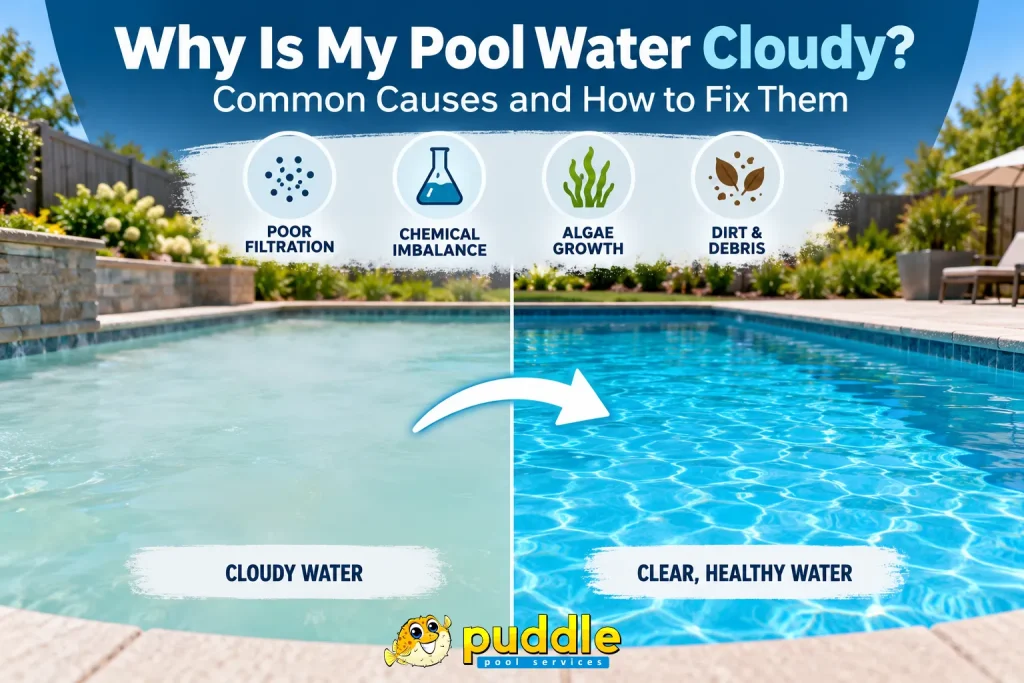
Is it safe to swim in a cloudy pool?
Not if you can’t see the bottom. The CDC’s advice before getting into any pool is to make sure you can see the drain at the bottom of the deep end. Cloudy water hides swimmers in trouble, so stay out until the water is clear again.
Public pools have a clear rule for this: under the CDC’s Model Aquatic Health Code, the water must be clear enough that the bottom is visible, and in Ontario a black disc at the deepest point must be visible from 9 metres away on the deck. Your home pool deserves the same standard.
The most common causes of cloudy pool water
1. pH or alkalinity too high
When total alkalinity runs high, pH becomes hard to control and tends to climb. The Model Aquatic Health Code lists cloudy water, scale and filter problems among the results. High pH also makes chlorine less effective: the CDC notes that as pH goes up, chlorine’s ability to kill germs decreases, especially above 8.0.
2. Too much calcium
Hard water and a lot of topping up let calcium build up. In the Model Aquatic Health Code’s words, “too much calcium causes cloudiness and scale formation.” When pH, alkalinity and calcium are all high together, the water is “oversaturated” and minerals start to drop out of it as a cloudy haze and scale on tile and equipment.
3. A filter that isn’t keeping up
Your filter is what physically pulls fine particles out of the water. If filtration is poor, clarity declines. Body oils, sunscreen, cosmetics and hair products can coat the pleats of a cartridge filter, clog it and cut its capacity, so a filter can be running and still not cleaning well.
4. Oils, sunscreen and dissolved solids
Over time, minerals, chemicals, body oils and sunscreen build up in pool water. That build up can cause staining, cloudy water and reduce how well your sanitizer works.
5. Pollen, dust, rain and storm debris
Outdoor pools take in pollen, dust and rain, and storms can wash in leaves, dirt and runoff. After a storm, UF/IFAS Extension’s advice is to remove the debris from the pool and get the water treated and balanced.
What to check first
Test free chlorine, pH and total alkalinity, then look at the filter. Most cloudy pools have at least one reading out of range or a filter that needs cleaning.
| Test | Where it should be | Source |
|---|---|---|
| Free chlorine (pool) | At least 1 ppm; at least 2 ppm if your pool uses stabilizer (cyanuric acid). CDC gives 1 to 4 ppm as the typical range. | CDC |
| Free chlorine (hot tub) | At least 3 ppm | CDC |
| pH | 7.0 to 7.8 (Ontario’s public pool rule: 7.2 to 7.8) | CDC; Ontario Reg. 565 |
| Total alkalinity | 60 to 180 ppm | Model Aquatic Health Code; Ontario Reg. 565 |
| Calcium hardness | 200 to 400 ppm preferred (100 to 200 ppm for water above 90°F) | Model Aquatic Health Code annex |
The CDC recommends testing chlorine and pH at least twice a day when a pool is being used, with a DPD test kit for chlorine. Most homeowners don’t test that often, which is where weekly professional service helps.
How we clear a cloudy pool
- Test everything, not just chlorine: chlorine, pH, alkalinity and calcium together, so we fix the cause and not just the symptom.
- Rebalance in the right order: alkalinity and pH first, so the chlorine can do its job.
- Clean or service the filter: rinse or deep clean cartridges, backwash sand and DE filters, and check the pump is circulating properly.
- Brush, skim and vacuum so the filter isn’t fighting debris that has settled.
- Report what we found: every visit ends with an E-Report showing the readings, the chemicals used and before and after photos.
If you treat the pool yourself, follow the product labels exactly, wear gloves and eye protection and never mix pool chemicals together. Always add chemicals to water, not water to chemicals.
How to keep your pool from going cloudy again
- Keep pH, alkalinity and calcium in range, not just chlorine.
- Run the pump and filter every day and clean the filter regularly, more often in heavy swimming weeks.
- Clear leaves and debris quickly, especially after storms.
- Ask swimmers to rinse off before getting in to cut down on oils and sunscreen.
- Book regular service so small changes get caught before the water turns.
Cloudy pool? We can help
Your local Puddle team tests, rebalances and cleans the filter on every visit, and you get an E-Report with the readings and photos. Request a quote and hear back within 24 hours.
Sources
- CDC, Home Pool and Hot Tub Water Treatment and Testing
- CDC, What You Can Do to Stay Healthy in Swimming Pools
- CDC, What You Can Do to Stay Healthy in Hot Tubs
- CDC, Healthy Swimming prevention
- CDC, Model Aquatic Health Code (2024 code and annex)
- Ontario Regulation 565, Public Pools
- UF/IFAS Extension, Pools and Hurricanes
Frequently asked questions
Can I swim in a slightly cloudy pool?
Only if you can clearly see the drain at the bottom of the deep end. If you can’t, stay out until it clears.
Does high alkalinity cause cloudy water?
It can. High alkalinity makes pH hard to control, and high pH can lead to cloudy water, scale and weaker chlorine.
How long does it take to clear a cloudy pool?
It depends on the cause. A balance problem can clear once the chemistry and filter are sorted, while heavy debris or a badly clogged filter takes longer. We’ll tell you what to expect after testing.
Can a dirty filter make my pool cloudy?
Yes. Oils and sunscreen coat cartridge filters and reduce how much they can clean, and poor filtration lets clarity decline.