How often should you clean your pool filter?
Go by the pressure gauge, not the calendar. Equipment manufacturers advise cleaning or backwashing when the gauge reads 8 to 10 psi above the filter’s clean starting pressure. How fast you get there depends on your filter type, how long your season runs and how many leaves and how much debris land in the pool.
Your filter’s pressure gauge is the tool for this. Right after a clean, note the reading: that’s your clean starting pressure. As the filter traps dirt, water has a harder time getting through and the number climbs. When it’s 8 to 10 psi above that starting point, it’s time. The public pool code takes the same approach: filters are cleaned when pressure rises a set amount over the clean reading, as the manufacturer recommends.
On top of routine cleans, plan a deeper service once a year. Equipment manufacturers recommend taking a DE filter fully apart and cleaning it at least once a year, and public pools must inspect sand filters for depth and cleanliness at least once a year.
Cartridge, sand and DE: how each filter works
All three trap dirt as water passes through. A cartridge uses pleated fabric, a sand filter uses a deep bed of sand and a DE filter uses a fine powder coating on fabric grids.
Cartridge filters
Water flows through a pleated fabric cartridge that catches dirt on its surface. There’s no backwashing: when the cartridge is dirty, you take it out, clean it and put it back.
Sand filters
Water flows down through a bed of sand, and the sharp edges of the grains catch particles as the water passes. Clean water leaves through pipes at the bottom of the tank. To clean it, you backwash: run water backward through the sand to flush the dirt out to waste.
DE filters
DE stands for diatomaceous earth, a fine powder. Inside the tank are grids or tubes covered in fabric, and the DE forms a coating on that fabric. Water passes through the coating and leaves impurities behind. Equipment manufacturers rate DE filters at 1 to 3 microns, which means they can catch microscopic particles. DE filters are backwashed like sand, then given a fresh coat of DE.
Signs your filter is due for a clean
The pressure gauge is the main signal. Weaker flow from the return jets and water that’s losing its sparkle are the other two.
- Pressure is up: 8 to 10 psi over your clean starting pressure.
- Flow is down: a dirty filter is the most common reason for high pressure together with weak flow back to the pool.
- Clarity is slipping: the CDC’s public pool code notes that when filtration is poor, water clarity declines. If your water looks dull or hazy and your chemistry is in range, check the filter.
- Pressure climbs fast after a clean: that usually points to a filter that needs a deeper clean. It can also mean a cartridge, grids or sand near the end of their life.
Don’t put it off too long. The public pool code explains why. Dirt sticks harder to filter media the longer it sits. Trapped skin cells and other organic material react with chlorine and form combined chlorine. Heavy loads can also form “mudballs” in sand that lead to filter failure.
| Filter type | How it’s cleaned | Signs it’s due | Deeper service |
|---|---|---|---|
| Cartridge | Remove the cartridge, hose it inside and out with a spray nozzle, degrease it and let it dry | Pressure about 10 psi over the clean reading; weaker flow; hazy water | Replace when cleaning no longer brings pressure and flow back |
| Sand | Backwash until the water running to waste is clear | Pressure 8 to 10 psi over the clean reading; weaker flow; hazy water | Check sand depth and cleanliness once a year; replace sand that won’t come clean |
| DE | Backwash, then add fresh DE through the skimmer with the pump running | Pressure 8 to 10 psi over the clean reading; weaker flow; hazy water | Take apart and clean the grids at least once a year |
Pressure figures are general guidance from equipment manufacturers and the CDC’s public pool code. Your filter’s manual has the final word.
How to clean each type of filter
Rinse cartridges with a garden hose and degrease them. Backwash sand filters until the water runs clear. Backwash DE filters, then recharge them with fresh DE. Always follow your filter’s manual.
Cleaning a cartridge filter
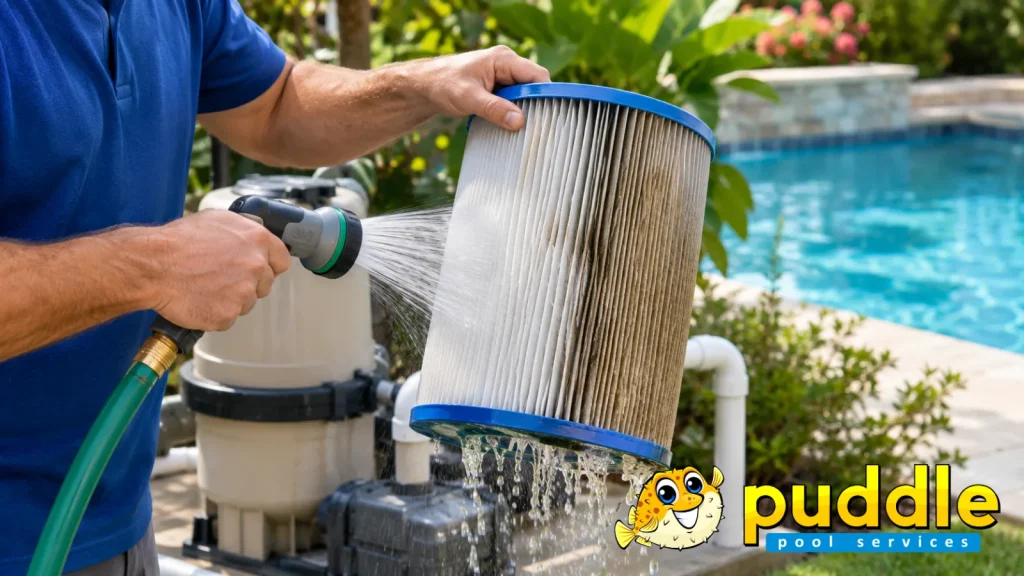
- Rinse: hose the cartridge inside and out with a garden hose and spray nozzle. Never use a pressure washer. It can drive dirt deeper into the fabric, damage the cartridge for good and spray germs into the air.
- Degrease: body oils, sunscreen, cosmetics and hair products build a greasy coating on the pleats that clogs them. The public pool code calls for degreasing every time a cartridge is cleaned, with an overnight soak in a filter cleaner or degreaser.
- Rinse again and dry: rinse well and let the cartridge dry completely. Drying helps kill some bacteria that survive cleaning.
- Acid only if needed, and never first: acid is only for heavy calcium or mineral deposits, and very few cartridges need it. Using acid before degreasing can set the grease and ruin the cartridge.
Public pools are advised to keep two sets of cartridges so one can soak and dry while the other is in use. It’s a handy approach at home too.
Backwashing a sand filter
With the pump off, set the valve to backwash and restart the pump so dirty water runs out to waste. Keep going until the water leaving the filter runs clear, then turn the pump off and set the valve back as your manual directs. Note your new clean starting pressure.
Backwashing and recharging a DE filter
Backwash the same way until the water runs clear. A good backwash removes only about 80 to 90% of the DE, and the filter needs a full fresh coat to work, so add new DE afterward. Pour it slowly into the skimmer with the pump running, using the amount listed on your filter’s label. Some DE filters are “bumped” with a handle instead of backwashed; follow the manual for yours.
Backwashing alone never fully cleans a DE filter, which is why manufacturers recommend taking it apart at least once a year to clean the grids with a degreaser, a hose (not a power washer) and an acid bath only if needed.
When does a filter need replacing?
When cleaning stops working. If pressure climbs right back after a proper clean or flow stays weak, the cartridge, the DE grids or the sand has likely reached the end of its life.
- Cartridges never regain 100% of their capacity after cleaning. The CDC’s public pool code annex estimates perhaps only about 80% is recoverable. Over time each clean gives back a little less, and once a cartridge can’t keep up it needs replacing with one that matches the manufacturer’s size and rating.
- Sand can clog with mineral deposits or other material that won’t backwash away. If pressure stays high after backwashing, the sand may need replacing.
- DE grids can clog with minerals or oils. If a deep clean doesn’t stop pressure climbing quickly, the grids need replacing.
We don’t give a set number of years because the sources we use don’t: it depends on how hard the filter works and how well it’s looked after.
How your filter and sanitizer work together
The filter removes particles; the sanitizer kills germs. You need both. A clogged filter leaves particles that shield germs from chlorine and makes clear water harder to hold.
The CDC’s public pool code notes that fine particles in the water can surround germs and shield them from disinfectants. Organic dirt left sitting in a filter also reacts with chlorine and forms combined chlorine. On the other side, a filter can’t kill algae: algae can clog a filter and push the pressure up, but it takes the right chemistry to clear it. That’s why good filtration and balanced water go hand in hand. If your water is already hazy, our guide to why pool water goes cloudy walks through the other causes to check.
What about hot tub filters?
Hot tub filters need regular care too. Warm water and a heavy load of body oils give germs an easy place to grow, so clean and replace hot tub filters as the manufacturer recommends.
The CDC points out that hot tubs run at temperatures in the most favorable range for Legionella growth, 77 to 113°F (25 to 45°C), and that sediment and biofilm help it grow. Its guidance for hot tub operators calls for regular replacement of cartridge filters, routine backwashing of sand and DE filters and steady flow across the filter 24 hours a day. The public pool code annex adds that hot tub cartridges face especially heavy oils and biofilm, that chlorine struggles to reach bacteria inside biofilm and that drying a cartridge completely is one effective way to control it.
Filter safety: what to do before you start
Turn off the pump and the power, release the pressure and air from the tank before opening it and never use a pressure washer on filter parts. Treat DE powder with care.
- Power off: switch off power to the pump and other pool equipment before opening the filter.
- Release trapped air and pressure: trapped air can compress and build pressure inside the tank, which can force the lid off. Open the air relief valve to let trapped air out before you open the tank, and again after a backwash.
- Go easy with DE: NIOSH lists the eyes and respiratory system as the parts of the body affected by diatomaceous earth dust. Pour it slowly, avoid breathing the dust and keep it out of your eyes.
- Mind the spray: rinsing a dirty cartridge can splash germs around, so keep your face clear of the spray and never use a pressure washer.
- Check where backwash water can go: backwash and cartridge cleaning water should be drained according to your local rules, and DE can settle in sewer pipes.
How Puddle looks after your filter
Filter care is part of our ongoing pool and hot tub maintenance. Every pool is different, so how often your filter gets cleaned depends on your pool, your filter and how much it is used.
- A schedule that fits your pool: we watch the pressure gauge, flow and water clarity and set the cleaning schedule around what your filter needs.
- Clean when it’s due: rinse and degrease cartridges, backwash sand and DE filters and recharge DE.
- Flag wear early: if a filter isn’t recovering after cleaning, we’ll tell you and talk through the options.
- Report what we found: every visit ends with an E-Report showing the readings, the chemicals used and before and after photos.
Let us take care of the filter
Filter care is part of your local Puddle team’s ongoing maintenance, on a schedule that suits your pool or hot tub, and every visit ends with an E-Report showing the readings and photos. Request a quote to get started.
Sources
- CDC, Model Aquatic Health Code, 2024 code
- CDC, Model Aquatic Health Code, 2024 annex
- CDC, Controlling Legionella in Hot Tubs
- CDC NIOSH Pocket Guide, Silica, amorphous (diatomaceous earth)
- Pool equipment manufacturer owner guidance on filter pressure, backwashing, DE recharge and filter safety
Frequently asked questions
How often should I clean my pool filter?
Clean or backwash it when the pressure gauge reads 8 to 10 psi above its clean starting pressure. That comes around faster when lots of leaves and debris land in the pool. Add a deeper clean once a year.
Does backwashing fully clean a DE filter?
No. A proper backwash removes about 80 to 90% of the DE. Add fresh DE after every backwash and take the filter apart for a full clean at least once a year.
Can I use a pressure washer on my filter cartridge?
No. High pressure drives dirt deeper into the fabric, can damage the cartridge for good and sprays germs into the air. Use a garden hose with a spray nozzle and a degreaser instead.
Can a dirty filter make my pool cloudy?
Yes. When filtration is poor, water clarity declines, and particles left in the water can shield germs from chlorine. If the pressure is up and the water is hazy, clean the filter and test your chemistry.