Welcome back to your backyard crash course! We recently covered the critical steps to take the moment you inherit a hot tub or swimming pool. Now that you’ve got a clean bill of health, it’s time to talk about the day-to-day care in our local Carolina climate. Missed it? Click here.
To keep your water pristine, you must master the Triangle of Care: Circulation, Filtration, and Balancing.
In Part 3, we’ll dive deep into circulation and filtration. For this article, we are focusing entirely on Balancing—the wonderful, wild world of water chemistry. You cannot see it but there’s a delicate ecosystem in your water! One chemical reading can affect another giving you false results during testing if mismanaged. When levels are out of the target range, slowly balancing in the right order is better than too much chemical too fast.
While pools and hot tubs are very different beasts, the chemistry fundamentals are identical. If you have a spa connected directly to your swimming pool, a shared spillover system circulates water between both vessels, making management even easier. Let’s dive in.
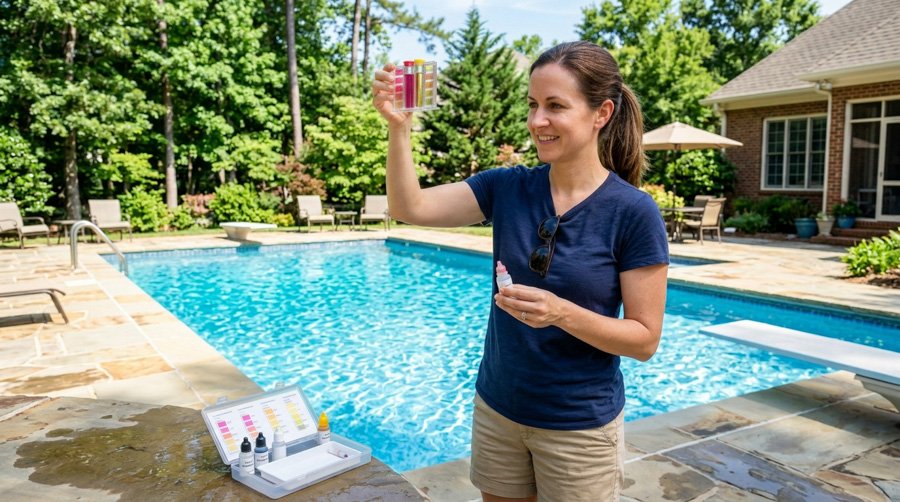
1. Ditch the Strips, Get a Real Test Kit
Testing strips are incredibly easy to use, but their accuracy leaves a lot to be desired. If you really want to protect your investment, upgrade to a high-quality liquid test kit.
Parenting bonus: Want to teach your kids some practical, hands-on chemistry? Pools and hot tubs are a fantastic, real-world laboratory. Put them in charge of the test kit and watch them learn!
2. Not All Chemicals Are Created Equal
Just like there is a noticeable difference between organic and non-organic vegetables at the grocery store, there is a massive difference in pool chemicals. Discount big-box store chemicals are frequently packed with inactive fillers, binders, and excess cyanuric acid (stabilizer) or copper. Over time, these fillers accumulate in your water, leading to “chlorine lock” or ugly surface staining. Investing in professional-grade aquatic chemicals from specialized brands yields far superior results, requires smaller doses, and saves you money over the course of the season.
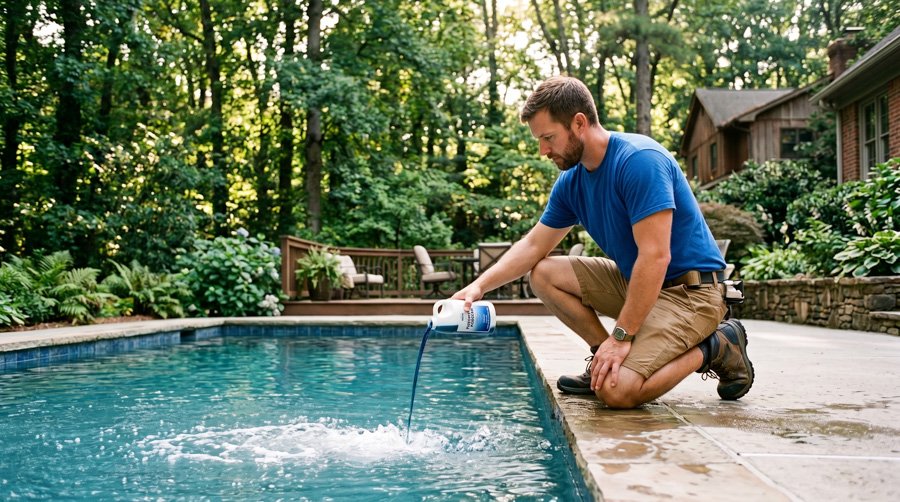
Safety Warning: Raw pool chemicals can be hazardous. Always handle chemical additions yourself, store chemicals securely, and keep children at a safe distance during application.
Tired of chemical math and storing hazardous jugs? Call us at 704-741-2185 to schedule your expert water balancing service using high-grade aquatic formulations across Charlotte, Lake Norman, Matthews and more.
3. The “Clear Water” Trap
Here is an important point for pool and hot tub ownership: Just because the water is clear, doesn’t mean it’s safe.
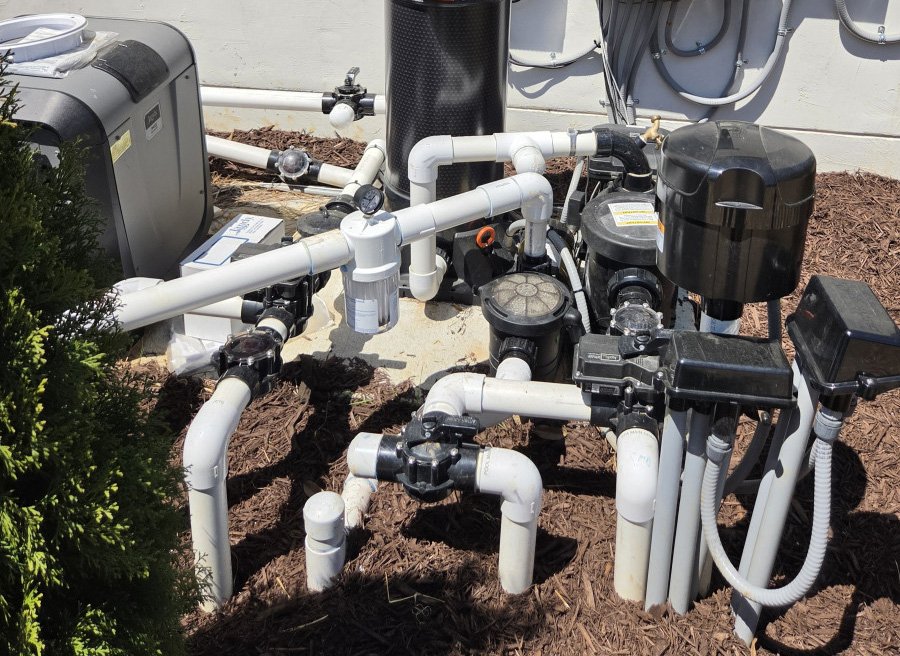
Clear water can still harbor invisible bacteria or viruses, and it may be actively destroying your pool equipment behind the scenes. Unbalanced water chemistry is a silent killer:
- Low pH / Low Total Alkalinity: Makes water aggressive and acidic, which rapidly corrodes copper heat exchangers in gas heaters, pitting concrete plaster and eroding vinyl liner elasticity.
- High pH / High Calcium Hardness: Causes calcium scale to form inside heat exchangers, pump impellers, and saltwater cell plates, drastically shortening their lifespan.
Summer afternoon thunderstorms in Charlotte frequently dump acidic rainfall and organic nitrogen into your pool, rapidly dropping pH levels and consuming free chlorine even while the water still looks visually clear.
4. The Truth About Saltwater Pools
Are you excited because you bought a house with a saltwater pool? They are fantastic and certainly feel softer on your skin, but there is a common misconception we need to clear up: the salt is not what sanitizes the water.
Through an electrolytic process, the system converts salt – which is chemically no different than what you sprinkle on your French fries – into chlorine. Yep, your saltwater pool is actually a chlorine pool!
Because salt generators continuously produce chlorine while running, pH levels naturally tend to drift upward over time. Saltwater pools require routine testing and pH adjustments (typically adding muriatic acid) just like traditional chlorine pools.
Furthermore, in areas with mineral-dense well water—like Mooresville, Davidson, and rural Union County—calcium scale will coat the cell’s internal titanium plates if chemistry isn’t monitored, shutting down chlorine production.
5. Work Smarter, Not Harder
If you want to reduce your weekly maintenance routine, consider upgrading your pad with an automated chemical sensing and dosing system.
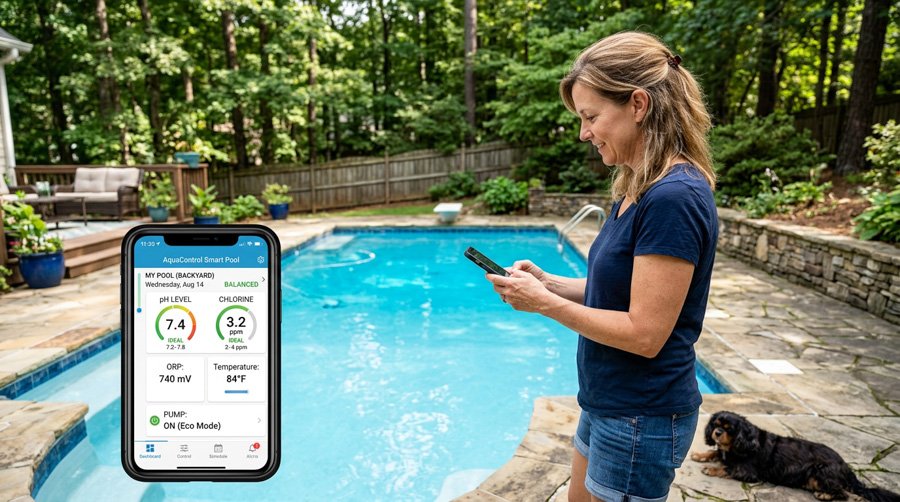
Smart automation controllers utilize pH and ORP (Oxidation-Reduction Potential) probes to monitor your water’s sanitizer and acidity levels 24/7. When levels drop during intense Carolina heat waves or after a heavy pool party, the system automatically doses exact amounts of chlorine or acid. This keeps your water perfectly balanced around the clock and takes the chemical guesswork off your plate.
6. Specialty Treatments: Algaecides, Phosphates, and Beyond
While primary sanitizers and pH balancers handle daily water sanitation, Charlotte’s unique climate—heavy spring pine pollen, sudden summer thunderstorms, intense humidity, and rich surrounding canopy—often demands target specialty treatments. Think of these as your pool’s immune boosters: they tackle stubborn water clarity issues, starve off potential algae blooms before they start, and protect your expensive equipment from mineral damage.
1. Phosphate Removers (Starving the Algae Buffet)
- What They Do: Phosphates are compounds derived from lawn fertilizers, decaying leaf debris, pine pollen, and heavy rainwater runoff. While harmless to swimmers, phosphates are the ultimate “buffet food” for algae. High phosphate levels allow green or yellow algae to rapidly bloom, even when chlorine levels seem adequate.
- Carolina Context: Following early spring “Pollening” or heavy summer storms in tree-heavy areas like Matthews, Myers Park, or Waxhaw, phosphate levels can surge overnight.
- The Fix: Have your water tested for phosphates regularly. Applying a commercial-grade lanthanum-based phosphate remover precipitates phosphates out of solution so your filter can remove them, keeping target levels below 100 ppb (parts per billion).
2. Preventative Algaecides (Insurance, Not a Cure-All)
- What They Do: Algaecides act as a secondary defense layer alongside your primary sanitizer. High-quality, non-foaming algaecides (such as Polyquat 60) disrupt algae cell walls, making it easier for free chlorine to destroy microscopic spores before they take root on pool surfaces.
- Pro-Tip: Algaecides are preventative measures, not magic remedies for an active green swamp. If your pool is already green, high-level shock oxidation, filtration, and brushing are required. Avoid cheap copper-based algaecides, which can cause dark metallic staining on plaster or vinyl liners and turn light-colored hair green.
3. Natural Enzymes (Organic Sludge Busters)
- What They Do: Enzymes are biological catalysts that break down non-living organic waste—bather body oils, sweat, cosmetics, sunscreens, and pollen—that pool sanitizer struggles to burn off efficiently.
- The Benefit: Organic waste creates ugly “scum lines” along the tile line and coats filter cartridge pleats in greasy film. Routine weekly enzyme treatments digest these organics, dramatically reducing chlorine demand, keeping water sparkling, and extending the time between filter cartridge cleanings.
4. Water Clarifiers & Flocculants (Polishing the Crystal Look)
- What They Do: When fine dust, pollen, or dead algae particles are too microscopic for your filter media to trap, the water takes on a dull, hazy appearance.
- Clarifiers: Coagulate tiny, suspended particles into larger clumps that your filter cartridge or sand bed can easily catch over 24 to 48 hours of circulation.
- Flocculants (“Floc”): Rapid-acting formulas that bind suspended debris and sink it directly to the pool floor overnight. Flocculants require vacuuming the settled cloud directly to “Waste” (bypassing the filter tank), making them an emergency fix after heavy red clay storm washouts in South Charlotte or Union County.
5. Scale & Metal Sequestering Agents (Stain Protection)
- What They Do: Metal sequestering agents bind dissolved minerals—such as iron, copper, and calcium—in a chemical “hold” so they cannot drop out of solution and stain pool surfaces or coat saltwater cell plates.
- Carolina Context: If your home in Lake Norman, Davidson, or Mooresville uses private well water, or if your pool features copper heat exchangers, applying a routine metal chelating agent prevents orange, brown, or teal surface staining when adjusting pH or shocking the water.
Feeling Overwhelmed? We’ve Got You.
Does all this chemical balance math sound intense? Are you feeling a bit overwhelmed by testing schedules and dosing charts? You aren’t alone, and you don’t have to figure it out by yourself!
A pool or spa is meant to bring your family joy and relaxation—not weekend stress. That is where the team at Puddle Pools comes in. Our comprehensive weekly service plans across Charlotte, Lake Norman, Matthews, Huntersville, Ballantyne, Waxhaw, Concord, and Mint Hill eliminate this chore from your to-do list. We handle the water chemistry, skimming, brushing, and equipment health checks so you can focus on making summer memories.
Give us a call at 704-741-2185 or request a free quote. Our Charlotte team is standing by.
Frequently Asked Questions
Why are liquid pool test kits better than test strips?
Liquid test kits measure chemical concentration levels with significantly higher accuracy and precision than test strips, which are prone to color-bleeding, humidity degradation, and inaccurate reagent readings.
Is a saltwater pool chemical-free?
No. Saltwater pools use an electrolytic salt cell to convert salt into chlorine, meaning they are still sanitized by chlorine and require regular chemical testing for pH, alkalinity, and cyanuric acid.
Can crystal clear pool water still damage my equipment?
Yes. Water can look perfectly clear while having extremely low pH or improper calcium hardness levels. Corrosive water actively degrades metal heat exchangers, corrodes pump seals/bearings, and etches pool finishes over time.
How do local Charlotte weather patterns impact pool chemistry?
Charlotte experiences high summer temperatures, intense sunlight (UV exposure that burns off un-stabilized chlorine), and sudden afternoon thunderstorms. Rainwater dilutes chemical concentrations and lowers pH, while organic debris and heat consume free chlorine rapidly, making routine weekly testing essential.
Can algaecide fix a green pool overnight?
No. Algaecides are preventative treatments designed to stop algae spores from growing. Clearing an active green pool requires elevated chlorine shock levels to reach breakpoint chlorination, continuous filtration, deep brushing, and proper water balancing.