Louisville Leak Detection
Puddle Pool Services provides pool and hot tub leak detection in Louisville and the surrounding area, including Lexington and southern Indiana. Pressure testing checks each plumbing line and dye testing shows where water escapes at fittings, skimmers, lights, returns and cracks, all without digging. You are then shown where the leak is and what the repair options are.
- Non-Invasive Testing
- Test Structures & Plumbing
- Fully Insured Staff
- Expert Leak Repair
- Pressure & Dye Testing
- 5-Star Rated

video: init
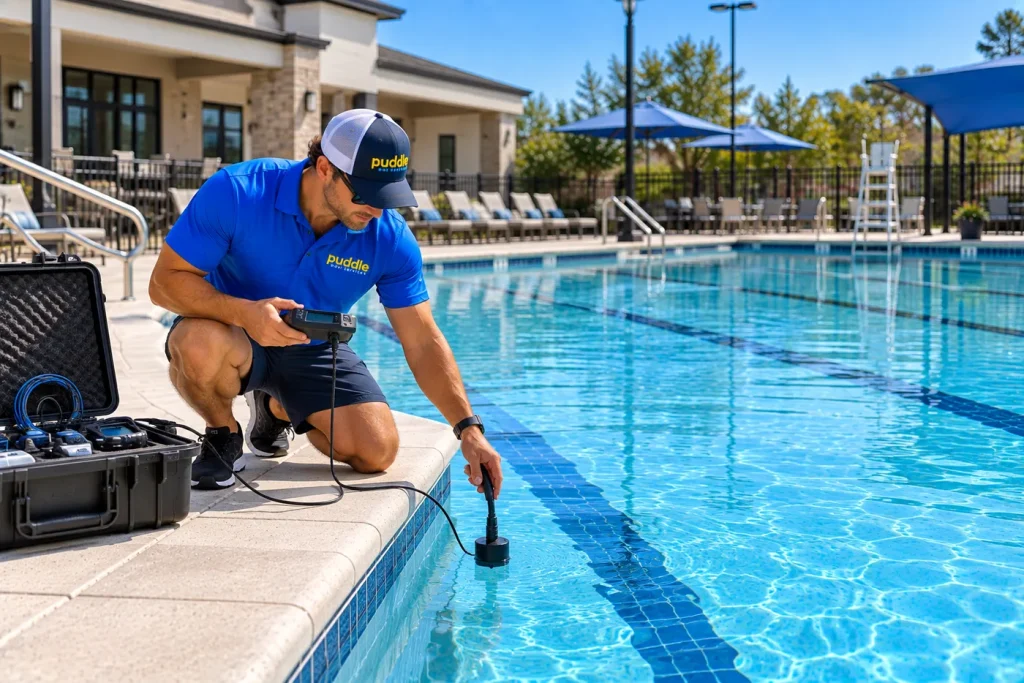
Leak or a hot Kentucky summer?
Some water loss is normal. NOAA's 1991 to 2020 normals put the July average high at 89.0 F at Louisville International, with about 42.7 days a year at or above 90 F. Heat, wind and heavy use all take water out of a pool. Suspect a leak if the water drops faster than the weather can account for, if it keeps dropping with the pump switched off, if soil around the pool or equipment pad never dries out or if topping up has become a job you do every few days. For a quick check at home, fill a bucket with pool water, stand it on a step and compare the level inside it with the pool level a day later. If the pool falls noticeably more, book a leak detection visit to confirm it.
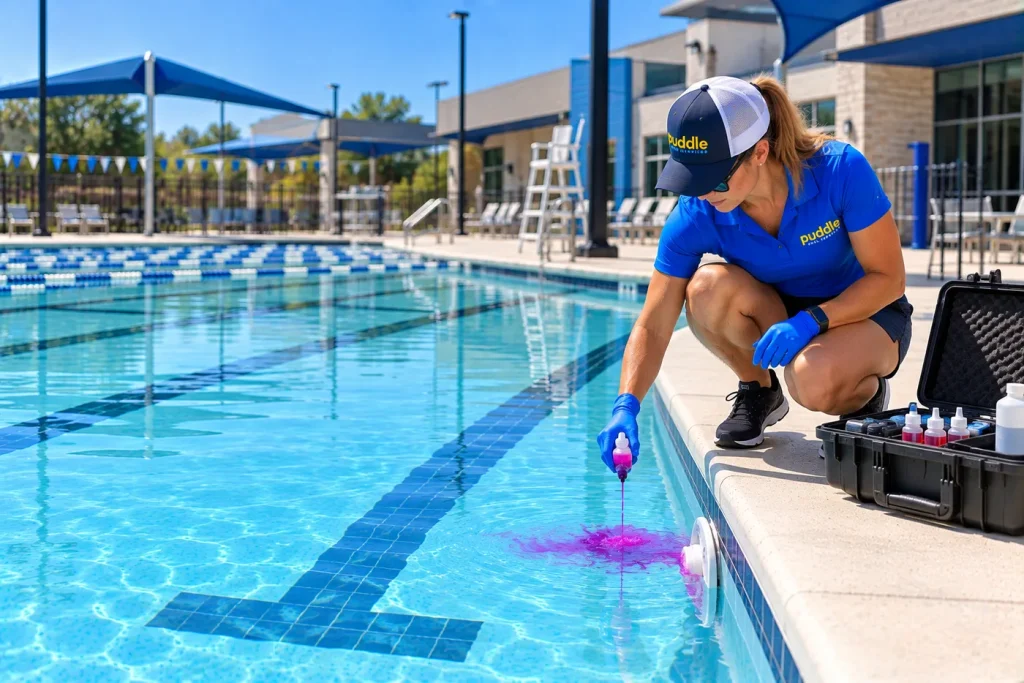
Finding the source without digging
Testing happens in stages rather than by guesswork. Pressure testing checks each plumbing line on its own, separating plumbing leaks from leaks in the shell or liner. Dye released near a suspect spot then reveals where water is escaping at fittings, cracks, lights, skimmers and returns. It is worth testing every line even when the leak seems obvious, because a second leak is easy to miss. Vinyl liners tend to leak through tears, punctures or around fittings and faceplates, while concrete and plaster pools are more likely to leak through cracks or at tile lines, lights and returns. The testing works from the pool and the equipment, so nothing is dug up to find the leak. The same approach works on hot tubs, adjusted for their jets and plumbing.
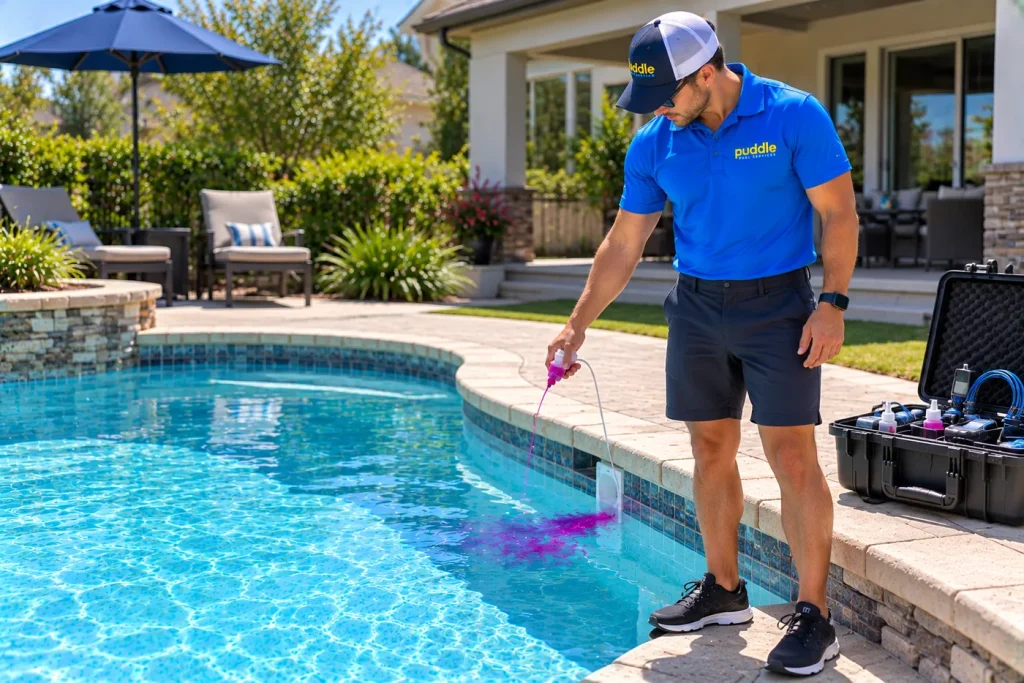
Refilling a leaking pool: credits have limits
Local billing rules give another reason not to keep refilling. Louisville Water says customers can request a pool credit on the sewer charge directly from MSD and calls it the preferred way to fill a pool, but only one pool credit is issued per year. Water that keeps escaping after that fill is simply lost.
Jeffersonville's Wastewater Department offers a sewer credit for pool fill water once per 12 months, but only if no pool water goes to the sanitary sewer and the customer consents to an annual on site inspection. A pool drain tied into the city sewer must be disconnected and rerouted to a storm sewer before a credit is granted. In New Albany, the Municipal Utilities Summer Watering Program waiver has a Pool Adjustment section. Extra use such as filling a pool before the program starts is considered case by case with proof of pool size. Keep a note of how much water you add and when. That record helps the test.
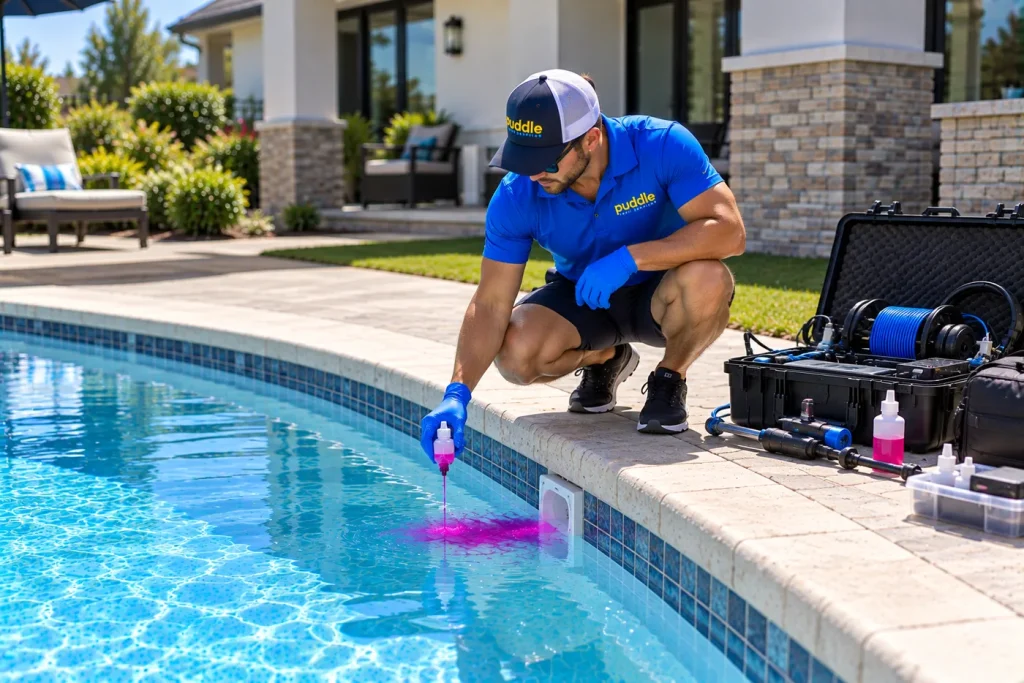
Why a small leak matters
A pool holds a large volume of water, so a small leak adds up quickly. Chemistry cannot hold steady while treated water keeps draining away, the pump and circulation system are strained and water escaping into the ground can damage landscaping and, over time, the structure around the pool. Keep the level above the skimmer while you wait for a test so the pump does not run dry. Tell us if the level is falling fast so the visit can be prioritized. In Louisville, fill water from Louisville Water averages a pH of 8.6 and carries chloramines, so a pool that is constantly topped up keeps drifting out of balance as well as losing water.
After the leak is located
We point out the leak and walk you through the ways to fix it. Leaks at fittings, skimmers, lights or small cracks can often be repaired directly. Bigger structural work or buried plumbing is quoted as its own job, so you decide knowing the whole picture. Digging is only discussed once a leak is confirmed in a buried line. Even then, the testing shows where to open up rather than searching blindly. If a repair means lowering the water, Louisville MSD's pool draining guidance applies: do not drain during or within 48 hours after rain, dechlorinate first and discharge no faster than 30 gallons per minute to a grassy area or a sanitary sewer cleanout on the property, never toward a neighbor.
Louisville Leak Detection: Frequently Asked Questions
Can I drain my pool in Louisville?
Yes, following Louisville MSD's pool draining guidance. Do not drain during or within 48 hours after rain, dechlorinate first and let the pool sit at least 10 days after chemical treatment, then discharge no faster than 30 gallons per minute to a grassy area large enough to absorb it or a sanitary sewer cleanout on your property. Never direct the water toward neighboring properties. Confirm the details with MSD before draining.
Can I get a sewer credit for filling my pool in Louisville?
Yes. Louisville Water says customers can request a pool credit on the sewer charge directly from MSD, calling it the preferred way to fill a pool rather than a temporary meter. Only one pool credit is issued per year. If you find yourself refilling more than once in a season, a leak test is worth considering.
Where can pool water be drained in Jeffersonville?
Jeffersonville's Wastewater Billing Adjustment Policy points pool owners to the city's drainage ordinance, which requires pool water to be discharged into the storm water system or the ground. Pool chemicals are not to reach surface waters or storm drains, so the water must be neutralized first. A pool drain connected to the city sewer has to be rerouted to a storm sewer before a pool fill credit is granted. Confirm with the city's Wastewater Department before draining.
Can a hot tub or spa leak be detected the same way?
Yes. Spas and hot tubs have plumbing, jets and fittings that can leak just like a pool. The same testing approach applies, adapted to the spa's equipment.
Does a vinyl liner pool leak differently from a concrete pool?
The usual suspects differ. Vinyl liners tend to leak through tears, punctures or around fittings and faceplates, while concrete and plaster pools are more likely to leak through cracks or at tile lines, lights and returns. Dye testing works on both.
Watch what we do
-
Residential Services
-
Commercial Services
Other services we offer in Louisville


Areas we serve
- Lexington
- Jeffersonville
- Georgetown
- New Albany
- Richmond
- Nicholasville
- Danville
- Frankfort
- Clarksville
- Winchester
- Mount Washington
- Shelbyville
- Berea
- Shepherdsville
- Lawrenceburg
- Versailles
- La Grange
- Sellersburg
- Paris
- Harrodsburg
- Charlestown
- Mount Sterling
- Fairdale
- Cynthiana
- Crestwood
- Wilmore
- Prospect
- Floyds Knobs
- Corydon
- Taylorsville
Where you can find us
Talk to us
So Why Puddle for Leak Detection in Louisville?
-
Transparent Pricing
That’s Right. No Hidden Prices. Up Front and Straight Forward Pricing.
-
E-Reports
Your Service Sent in an E-Report, in Real Time. What Was Done, What Chemicals Were Used, What Your Levels Are At etc. All With Before & After Pictures, Time Stamped In and Time Stamped Out.
-
Happy Snappy Techs
Fully uniformed, CPO certified technicians in fully wrapped vehicles, so you always know who is at your gate and that your pool is in trained hands.
Ready to book Leak Detection in Louisville?
Book online in under a minute, or call and someone will actually pick up.

Accredited, certified and reviewed