Louisville Pool Maintenance
Puddle Pool Services maintains pools in Louisville and the surrounding area, including Lexington, Clarksville and Shelbyville, looking after the pump, filter, heater, valves and plumbing as well as the water. Each visit checks filter pressure, the baskets, visible plumbing and the condition of the surface, covers and fittings, then tests and balances the chemistry so wear is caught while it is still a small fix.
- Drop water levels to protect drains
- Clean debris before closing and upon opening
- Set the stage for a quick and easy openings
- Visual Inspections of components and mechanisms
- Create a safe environment for swimmers

video: init
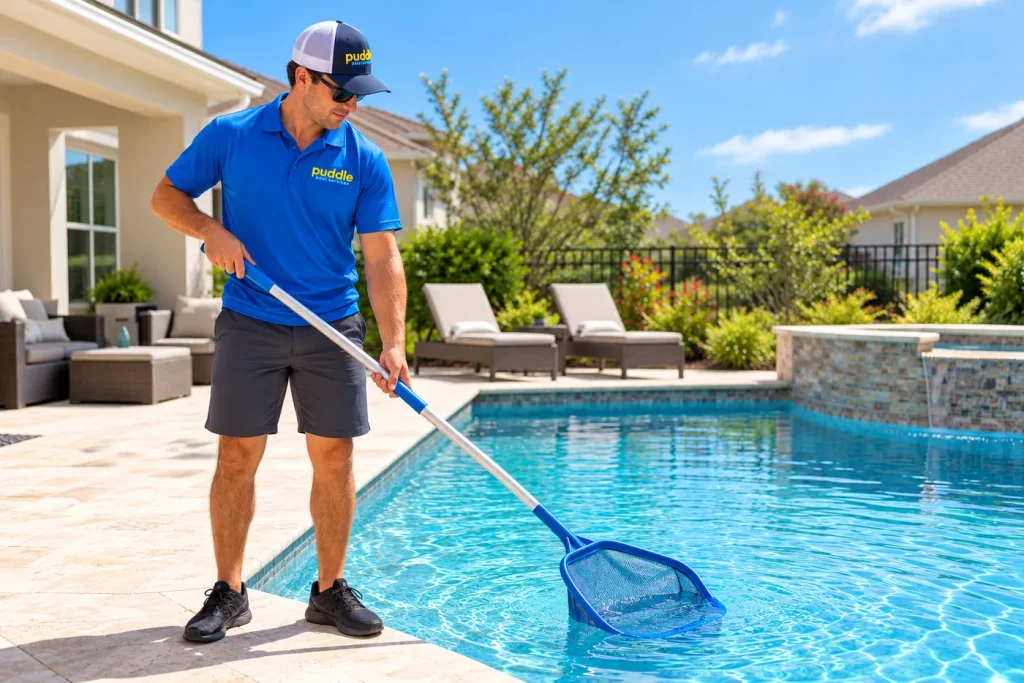
Maintenance looks after the system behind the water
A pool can look perfectly clear while the equipment that keeps it that way is wearing out. Cleaning deals with the water and the surfaces. Maintenance takes in the whole circulation system too: the pump and its baskets, the filter and its pressure reading, the heater, the valves and whatever plumbing is visible. Wear on the liner or plaster, on covers and on fittings gets noted too. Equipment trouble rarely arrives all at once. The pool starts taking longer to clear, the pump sounds different, the gauge drifts away from its usual number or the chemistry stops holding. Mention any of those when you notice them, because equipment problems are cheaper to deal with early than late.
Louisville fill water, line by line
Every top up brings the utility's chemistry into your pool, so it helps to know what is in it. Louisville Water's 2025 Water Quality Report lists the finished water at 31 mg/L of calcium, 13 mg/L of magnesium, 26 mg/L of sodium, 33 mg/L of chloride and 56 mg/L of sulfate, with total dissolved solids of 225 mg/L. The utility disinfects with chloramines, and its distribution system ran an annual average of 2.69 ppm in 2025 within a range of 1.97 to 3.46 ppm. None of that is a problem in itself. It is a baseline. When a pool's readings move away from what the fill water would explain, the gap is a clue worth following, whether it points to evaporation, heavy use or something in the equipment.
Lexington water depends on the plant
Kentucky American Water runs three plants on one interconnected system, and some areas receive a blend. Its 2025 report says Kentucky River Station supplies the south half of Fayette County, Clark County and southern Bourbon County. Richmond Road Station mainly serves downtown Lexington inside New Circle Road, while Kentucky River Station II serves Owen and Scott counties plus northern Fayette and Bourbon. The plant averages differ. Alkalinity ran 77, 102 and 91 mg/L, calcium 19, 40 and 34 mg/L and pH 7.5, 7.7 and 7.5. A pool in Scott County and a pool near downtown can start from different water. Alkalinity or pH that sinks too low makes water corrosive to heaters and metal fittings, and readings that climb too high leave scale, so balancing starts from the water your pool actually receives.
Filters, backwash and the Indiana rule
The filter does most of the work of keeping water clear, and a rising pressure reading is usually the first sign it needs attention. Cleaning or backwashing on time spares the pump from straining against a clogged filter. On the Indiana side of the river, where backwash goes is a code question. Section R326.25.1 of the 2020 Indiana Residential Code sends backwash water to a sanitary sewer through an approved air gap, to an approved subsurface disposal system or to other means the Indiana Plumbing Code and 327 IAC allow. In Jeffersonville the chemistry also starts from a different place. Indiana American Water says its groundwater supplies are generally disinfected with chlorine rather than chloramines, and its 2025 Southern Indiana distribution average was 1.35 ppm, within a range of 0.46 to 1.95 ppm.
A schedule that follows the season
Most owners want maintenance heavier through the swimming months and lighter outside them, and some equipment work is easier while nobody is swimming. The warm stretch here runs well into autumn. NOAA's 1991 to 2020 normals put the September average high at 82.2 F at Louisville International and 81.8 F at the McAlpine Locks, with Lexington at 80.2 F, so the water can stay warm enough for algae after the summer holidays end. A pool that sits unused still needs either maintaining or closing properly, because untreated standing water and idle equipment are where trouble builds quietly. Pump run time follows similar logic. It should be long enough to turn over the full volume, which depends on your pool and pump rather than one rule, and your technician can tell you what suits your setup.
Louisville Pool Maintenance: Frequently Asked Questions
Is Jeffersonville tap water disinfected the same way as Louisville's?
No. Louisville Water uses chloramines, but Indiana American Water treats groundwater systems like the Greater Jeffersonville Area supply with chlorine in most cases. Its 2025 report puts the Southern Indiana distribution system at 1.35 ppm on average, varying between 0.46 and 1.95 ppm. Fill water on the Indiana side therefore behaves differently in a pool, which is one more reason to test each pool on its own.
Can I drain pool water into the sanitary sewer in Lexington?
Ask the city before you do. Lexington's sanitary sewer rule, Code Section 16-42, keeps out unpolluted drainage such as storm and surface water but says nothing specific about pools. The storm system is the route the code does address: Section 16-93 permits pool water there once chlorine is under 1.0 part per million and no avoidable erosion results. LFUCG Water Quality can tell you which route fits your pool.
Which Louisville neighborhoods do you cover?
We look after pools across Louisville, including Downtown, NuLu (East Market District), Old Louisville, Butchertown, The Highlands and Crescent Hill. The full list of areas is on our Louisville page. If you do not see yours, get in touch and we will confirm.
Can maintenance be scheduled around the season?
Yes, and most customers do. Service is usually heavier through the swimming season and lighter outside it, and some equipment work is better done when the pool is not in use. It is worth discussing the pattern rather than assuming one schedule fits the whole year.
Why does water chemistry matter for my equipment?
Unbalanced water does more than look bad. Water that drifts too low in alkalinity or pH becomes corrosive to metal parts, heaters and fittings, while water that runs high tends to leave scale. Keeping chemistry in range is one of the simplest ways to protect equipment.
Watch what we do
-
Residential Services
-
Commercial Services


Areas we serve
- Lexington
- Jeffersonville
- Georgetown
- New Albany
- Richmond
- Nicholasville
- Danville
- Frankfort
- Clarksville
- Winchester
- Mount Washington
- Shelbyville
- Berea
- Shepherdsville
- Lawrenceburg
- Versailles
- La Grange
- Sellersburg
- Paris
- Harrodsburg
- Charlestown
- Mount Sterling
- Fairdale
- Cynthiana
- Crestwood
- Wilmore
- Prospect
- Floyds Knobs
- Corydon
- Taylorsville
Where you can find us
Talk to us
So Why Puddle for Pool Maintenance in Louisville?
-
Transparent Pricing
That’s Right. No Hidden Prices. Up Front and Straight Forward Pricing.
-
E-Reports
Your Service Sent in an E-Report, in Real Time. What Was Done, What Chemicals Were Used, What Your Levels Are At etc. All With Before & After Pictures, Time Stamped In and Time Stamped Out.
-
Happy Snappy Techs
Fully uniformed, CPO certified technicians in fully wrapped vehicles, so you always know who is at your gate and that your pool is in trained hands.
Ready to book Pool Maintenance in Louisville?
Book online in under a minute, or call and someone will actually pick up.

Accredited, certified and reviewed